
A Cappella

The Clancys in Action

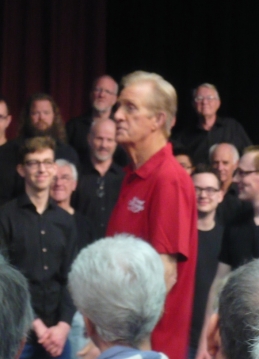
Jim Clancy: Not the best pic I've ever taken, but you can see some of the delight he is bringing to the singers on their facesJim Clancy: Not the best pic I've ever taken, but you can see some of the delight he is bringing to the singers on their facesIt was a no-brainer, at the recent BABS Convention, to go along to see Jim and Greg Clancy do a coaching workshop. You want to see how the current and founder directors of the world’s most successful barbershop chorus go about things; and if you’re me you also want to take notes and blog about it afterwards.

And it wasn’t a surprise to see Hallmark of Harmony take to the risers - since they will be representing BABS at the International Convention in Pittsburgh in just a few weeks, they were the obvious candidate for coaching. Then, when the singers took up position for the choreography, the penny finally dropped that I was about to see them coached on the song I had arranged for them. That was an exciting moment, though I did feel a bit dim for not having foreseen it.

Anyway, most of what they worked on would have been the same whatever the chorus was singing, so the rest of this blog post will stop being about me and go back to my original plan of writing about coaching methods. But the bit where Greg did focus in on the detail of the chart was wonderful - homing right in on the features that were there to make it exciting and bringing them into full musical technicolour.

Revitalising Songs with Signature

signature1

One of the dilemmas that faces any performer is how, on one hand, to keep their material fresh and interesting in performance while, on the other, rehearsing it deeply to a state of polish and absolute reliability. Or, to put it more bluntly, how do you stop yourself getting bored? Obviously, bringing new material in is part of the mix, but you can’t just keep throwing out the old too quickly, both because that is very wasteful of rehearsal time, but more importantly because both technical expertise and depth insight are built on extended engagement with the material.

This is what I went to help Signature Singers with last Sunday. They have a contest set that they are not done with in terms of the skills and artistry the songs will help them develop, but they were feeling a bit bogged down with it all. Their heads knew they would benefit from working with the songs further, but their hearts were getting a bit jaded.

Workshopping with the Barberfellas

Hey Big Spender!Hey Big Spender!

I spent Saturday afternoon in London doing a bespoke workshop with the Barberfellas, an a cappella ensemble who all also sing with the Pink Singers choir. As their name implies, they specialise in close-harmony music, some of which is barbershop in the purists’ sense (you don’t get much more classic than arrangements by Ed Waesche), and some more stylistically varied, including some material arranged in-house.

My remit for the afternoon fell into two main areas: first a focus on building the classic barbershop ‘ring’ in the sound, and second some work on engaging the audience, both through stagecraft and generating musical expression and variety in performance.

BABS Convention 2015

Hmm, it was actually nicer walking along the seafront than this makes it look!Hmm, it was actually nicer walking along the seafront than this makes it look!

Like many of the UK’s barbershop population (and more than a few from overseas), I spent the bank holiday weekend in Llandudno for the British Association of Barbershop Singers Convention. It seems the convention is getting near to growing out of Venue Cymru - not only did they have to run the prime show twice there was so much demand for tickets, but the main arena is getting too small for the numbers who want to watch the contests. It was also significantly harder to get a table in a restaurant than in previous visits, which tells you something about the relationship between major venues and the surrounding businesses.

Musings On Key Lifts

If my mother were writing this post, it would be tagged under my Soapbox category, and it would be a vehement denouncement of the use of the semitone key lift as a device for adding interest to repeated material. There would be particular attention to the work of John Rutter, in which she contends that it is a formulaic trick, so over-used that instead of perking up her attention it makes her heart sink with a feeling of ‘Oh no, not again’.

However, I have not yet entirely turned into my mother, so I am not going to be quite so doctrinaire. But neither am I resisting the inevitable process of family resemblance, so I’ll say she does have something of a point.

I spend rather more of my time in a cappella, as opposed to accompanied, choral worlds than she does, and so my reservations about semitone key lifts are more based around how badly they are often sung. The standard quip is that their main function is to allow a flatting ensemble to end in the same key that they started in.

A Cappella Spring Fest

The Contemporary A Cappella Stream in performanceThe Contemporary A Cappella Stream in performance

I spent Sunday at the fifth annual A Cappella Spring Fest to be held in the Cornerstone arts centre in Didcot. It’s a rather wonderful event, hosted by a couple of local choirs, whose ongoing collaboration has produced slick organisation and a confident and helpful team. If you’re anywhere near Oxfordshire on the second weekend in March next year, I’d recommend it as a way to spend a day with 120 like-minded singers.

The day involves plenary sessions at start and end for warm-up and work on the Fest Song all together in the morning, and then performances in the afternoon. It then offers a choice of classes for two sessions, then two sessions in genre-themed groups working on a piece to share at the end of the day. This year there were streams for gospel, classical, barbershop, a new-to-a-cappella group, and I was leading the contemporary a cappella stream.

MasterMixing it Up

mastermixLast weekend brought a visit from mixed quartet MasterMix for a coaching session. I’ve worked with a few long-distance quartets in my time, but this one is raising the stakes rather in terms of logistics: not content with a journey between Derbyshire and Essex to sing together, they bring their bass in from Sweden. It seems appropriate, really, that their first two contests together will have been in Ireland (last autumn) and Spain (coming up in April).

Long-distance quartets typically have a skill profile in which the individual singers are operating initially at a higher level than the whole. They will often have considerable experience in other ensembles through which they have honed their skills, and are motivated to take on the extra travel to work together by the opportunity to sing with people who can bring this experience to the table. By the same token, their opportunities to learn how they are going to operate as a unit are relatively few compared to a local quartet, but commensurately more intensive. If they can only meet every few weeks, they make a proper weekend of it.

Magenta Rehearsal Protocols

maglogoThis post started out as noting some info I wanted to share with the people who are starting with Magenta this New Year. And as I typed, facts blossomed into explanations, and I thought: you know what, I could publish this as a blog post rather than just sending it round by email, just in case anyone else finds it useful. Most of how choirs develop, after all, is by people sharing their ideas, and other people thinking, ‘Oh, I could just adapt that for my lot, and it would exactly meet such-and-such need.’

So, to our new singers: you will have already seen these things happening when you came to observe a rehearsal before joining. These are the protocols and rationales that lie behind the behaviours you observed.

...found this helpful?

I provide this content free of charge, because I like to be helpful. If you have found it useful, you may wish to make a donation to the causes I support to say thank you.


Archive by date

Syndicate content Syndicate content