
Building Choral Stamina

marathonI’ve had several conversations recently with directors about the challenges involved in learning big pieces. Big implies, at the most obvious level, pieces that go on for longer than usual, though that also usually brings with it a degree of expressive size too. There are three distinct dimensions to the stamina demands these pieces place on a choir, and while they are interrelated, it’s worth identifying them separately:

Keeping it Real

For all that all choral genres generally share an overall sense of shared ethos (executive summary: singing is a Good Thing To Do), moving between different traditions can throw up some interesting challenges. I had an interesting Facebook chat recently with a singer who has plenty of experience in the kinds of choir that simply ‘stand and sing’ – i.e. where it is about the music, not about the performers. He was talking about some of the challenges he’d had in moving into a world that was much more focused on personal expressiveness.

What he found was that, while he was quite comfortable finding his way into the mood of the music in a general way, his peers were asking for a more active narrative, particularly in the way he used facial expression. ‘And at this point ,’ he said, ‘one of two things tends to happen:

MacCoaching Session

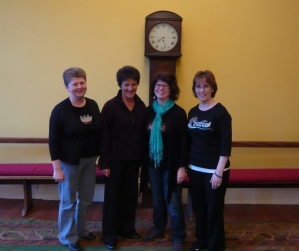
MacFourMacFourI had a trip up to Edinburgh at the weekend to work with MacFour quartet. They are a well-established ensemble with a consistent track record both as performers in their locality and in Sweet Adelines contest. Their goal for the coaching session was therefore to explore new rehearsal and performance techniques that will help them build on the skills they have already embedded. They have a really secure technical control over what they do, and wanted to focus the artistic and communicative aspects of their performance.

It was clear when we were corresponding to set up the trip that they are an organised quartet, and they like to have clear sense of method. So the task wasn’t simply a case of working on repertoire, but of providing them with processes and vocabulary they could apply beyond the specific songs we worked on.

BABS in Brum

The Great British Barbershop Boys perform their mammoth 'history of song' in the foyerThe Great British Barbershop Boys perform their mammoth 'history of song' in the foyer

Last Sunday saw the British Association of Barbershop Singers coming to my old home patch of Birmingham Conservatoire for their annual Quartet Prelims. This is the event at which quartets compete to qualify for the Convention in May, and at which the Youth Quartet and Senior Quartet contests are held. It has become an increasingly well-supported event in the barbershop calendar, both by quartets and by supporters.

This year they had over 50 entrants, and as a result chose to split the quartets between the venue’s two concert halls into parallel competitions. All the Senior quartets appeared in the Adrian Boult Hall, all the Youth quartets in the Recital Hall, and the quartets in the main contest were split between the two.

The Neurology of the Charismatic Aura

The importance of mythology for the experience of charisma can seem like a circular argument. In order for people to experience a leader as charismatic, the proposition goes, they need to believe in the existence of charismatic leaders. Well, er, yes.

The business management literature has gussied this up a little with the term ‘Romance of Leadership Disposition’, which is basically a measure of how much people are inclined to believe in the existence of and need for inspirational leaders. People with the disposition are more likely to find leaders charismatic, whilst those without it are the ones who cross their arms and sniff mistrustingly.

Syncopation or Rubato?

carolekingI have commented before in passing on the way that popular melodies from the 1960s onwards look - on paper – more rhythmically complex than tunes from the earlier parts of the 20th century. They appear to have a lot more syncopation, and they seem rarely to cadence exactly on the beat – instead either anticipating or delaying over the barline.

The reason for this is not, however, because popular music has particularly become more complex over time (you get examples of both simple and complex melodies throughout the 20th century), but because the processes of musical production have changed.

This All-too-solid (Female) Flesh...

Yuja WangJessica Duchen has been berating her fellow critics for getting into a swivet about concert dress. Her basic stance is: calm down and listen to the music, as that’s what matters. Which is a nice way of turning the complainers’ arguments back on them. If they object to female performers dressing in trendy and attractive clothing because classical music is supposed to be timeless and above the concerns of the flesh, then they should put their attention onto the performance instead of wittering on about mundane things like clothes.

Conducting Research: Science vs. Real Life

cond-choir-bond.jpgThe current issue of Research Issues in Music Education has an article examining the various functions of a conductor. In some ways it is an exemplary bit of research: well-rooted in the literature, clear in its rationale and methods, logical in the the drawing of its conclusions. But in other ways it demonstrates the problematic disconnect between conducting research as it appears in doctoral programmes and education journals and the lives of real musicians.

...found this helpful?

I provide this content free of charge, because I like to be helpful. If you have found it useful, you may wish to make a donation to the causes I support to say thank you.


Archive by date

Syndicate content