
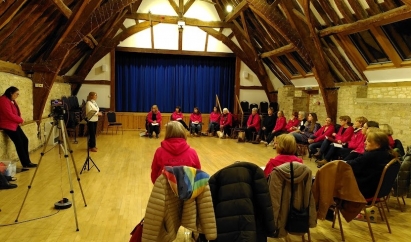
Refining the Conductor-Choir Bond with Fascinating Rhythm

FRfeb23When, as a coach, you participate in a process that sees a radical transformation, a real shift in skill level in a short time, it is tempting to feel like you are a superhero. But the real superheros on these occasions are the people who have made the leap. It is their combination of motivation, clarity about their needs, and trust in each other that sees the new skills crystalise as if out of a super-saturated solution. ‘Learning readiness’ is the key driver here, though the term itself doesn’t convey the magic of what it can achieve.

I spent last Thursday evening with Fascinating Rhythm, their director Jo Thorn having asked me to come down and work with them on refining the communication between conductor and singers. They were collectively finding themselves frustrated not to attain the clarity and precision they aspired to, and as the overall sound of the chorus improved, this need was coming more and more into focus.

How to Be an Engaging Conductor

I’ve been thinking on and off about something Jay Dougherty said in his session on rehearsal pacing at BABS Directors Academy in January, to which I had a classic ‘yes but…’ response. Always good for learning, these!

He made the point that if you want your rehearsal to keep moving, you need to be engaging. And if you don’t feel that you’re outgoing and energetic as a matter of course, this may require some acting, but that’s okay, it’s all part of the conductor’s role. Put some extra energy into your walk, make sure you vary your tone of voice, and everyone will be more alert and attentive.

At one level, this is very apt advice. A lacklustre demeanour will suck energy out of the room and will struggle to keep people focused. But at another, it has the potential to work out quite awkwardly for some people. Pretending to be Tigger when your personality is better suited to Owl could very easily come over as trying too hard and/or inauthentic (and thus not entirely to be trusted) – all of which would be counter-productive.

On Developing Your Vocal Range

After my first recent post on voicings for mixed barbershop choruses, I received a message from a singer who sings in both male-voice and mixed-voice choruses asking about practical advice for developing his upper range. So that guarantees that I have at least one interested reader for this particular blog post.

As is so often the way, a couple of headline points will be useful to start with before heading into the nitty-gritty. As I mentioned in my post on advice for older voices, range works very much on a use-it-or-lose it basis, so if you don’t regularly visit the outer edges of where you can currently sing, those edges will move closer together. You might not (probably won’t) need the extremes in much actual repertoire, but by keeping in touch with them you give yourself headroom for the rangier passages in your music.

A Busy Night with Cleeve Harmony

Natalie Feddon addressing the chorusNatalie Feddon addressing the chorus

It was all happening at Cleeve Harmony’s chorus night on Wednesday. They had a visit from LABBS Chair Natalie Feddon and a new member to be welcomed into the organisation, as well as two new songs to be coached on. I was there for the latter bit, but it was fun to be there for the other bits, especially as I’d not been able to join them for their 10th birthday celebrations the week before.

The two new songs we were working on were ones I’d arranged for them back in the autumn, so one was at the ‘basically learned but still finding our way round it’ stage and the other at the ‘started learning, but only the music team has sung it together yet’ stage. One of the fun things about coaching music in this very early stage of development is that you can explore global themes such as concept and groove that shape how people feel and understand the music while they’re still getting acquainted with it.

On Voicings for Mixed Barbershop Choruses, Part 2

In my previous post, we considered why mixed barbershop presents vocal challenges that are quite distinct from the single-sex forms of the genre. (In a nutshell, the standard distribution of vocal ranges for a single-sex group is a camel, but for mixed groups is a dromedary.)

We also considered some of the impacts of this structural feature. It affects individuals singers, as quite a few in any mixed chorus are likely to end up singing out of their best range. It also affects the group as a whole, through the impact of people singing outside their best range on the sound, and/or through difficulty populating the parts in an optimum balance. That post didn’t mention the expressive impact of singing out of range, but it’s something I’ve touched upon before more than once.

On Voicings for Mixed Barbershop Choruses

I am returning to this theme as a lot of people are grappling with the challenges of making a genre developed for and within single-sex ensembles work with mixed groups. Having interacted with a number of different ensembles in various capacities in recent times, I wanted to collate what I’ve learned from them about the difficulties they’ve faced and the solutions they have found.

First, though, it is worth thinking through why mixed barbershop can prove tricky, before looking at the consequences for lived experience, and what we can do about it. This may turn into more than one post; it has the feel of a question that expands as you think about it!

Exploring Recurrent Themes with Bristol A Cappella

Some days you find similar concepts coming up repeatedly in different musical contexts; Saturday was such a day with my friends at Bristol A Cappella. One of the advantages of days like this is that you find people get quicker at applying the concepts on successive encounters, and indeed that after a while you no longer have to point out where they need to apply them, as they’re figuring it out for themselves.

One theme for the day was of staying with a note right to the end of the phrase. Linguistically, the brain pretty much moves on when you get to the last syllable of a sentence; in general conversation we don’t tend to elongate them, but go straight to drawing breath for the next utterance. But when singing, it is very audible when the attention has moved on, even if people are holding the note for the notated length. You have to stay interested in it for the tone to retain integrity.

Tuning in to BABS Directors Academy

Jay's selfie captures to joy in the roomJay's selfie captures to joy in the room

The weekend saw the first in-person BABS Directors Academy since 2020 (and my first since 2019, as I missed the last one). We had Dr Jay Dougherty as our guest educator, who brings with him a deep and abiding understanding of the barbershop style along with higher degrees and HE teaching experience in choral conducting. He is probably most known in the barbershop world for having taken over Joe Liles’s ‘Tune it or Die’ course at Harmony University, which he has made his own by drawing on research undertaken in his doctoral studies. He led front and centre with this material, dedicating three consecutive sessions on Saturday to it.

...found this helpful?

I provide this content free of charge, because I like to be helpful. If you have found it useful, you may wish to make a donation to the causes I support to say thank you.


Archive by date

Syndicate content