
Crazy Copyright Case

soapboxOver on ChoralNet, they have a persistent running gripe about copyright legislation and the heavy-handedness with which big businesses in the music industry enforce it. I mostly try not to get too worked up about these things – it’s part of the landscape we work in and I have other more interesting uses for my emotional energy – though I do appreciate having voices of reason on the case lobbying for balance.

But there was a news story last week that has me mentally frothing at the mouth (if such a thing is possible). The music publisher Larrikin, who bought the copyright to ‘Kookaburra Sits in the Old Gum Tree’ in 1990, is apparently suing Men At Work for plagiarism, claiming that the flute riff in the 1981 song ‘Down Under’ is stolen from the girl guide tune.

Yorkshire Double

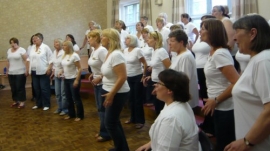
bradfordyorkOn Sunday night I had a trip up to Yorkshire to work with the combined voices of Pennine Chimes from Bradford and Main Street Sound from York. They have been rehearsing together once a month for the last few months, as well as coordinating their plans and approaches for each group’s weekly rehearsals, and as a result are operating very much as a single ensemble. Indeed, my only clue as to who originated with which chorus were their name badges!

During the second half of the coaching session we addressed an issue that besets so many barbershop groups: the way that introducing choreography seems to undo months of careful work on vocal production.

A Cappella and the Creation of Rhythm 1

Working in a timbrally-uniform medium such as unaccompanied voices has deepened my appreciation over the years for the insights that Grosvenor Cooper and Leonard B. Meyer provided into how rhythm works.

To ruthlessly summarise their key ideas:

  • Our experience of rhythm results from the perceptual organisation of relatively accented and unaccented sounds into coherent patterns.
  • An accent is created by any ‘stimulus marked for consciousness’ – that is, a thing that makes us notice it.
  • Consequently, any and all elements of a musical texture can participate in the creation of accent (and, thereby, rhythm).

What makes good music?

I keep thinking that, having worked in music all my adult life, I should be in some position to answer this question. But somehow, whilst I seem to be quite good at recognising it when I encounter it, theorising what it is that makes music good remains intractable.

I’m not the first person to puzzle over this of course. There are a number of theories knocking about, all of which have something to offer, but none of which are wholly satisfactory. For example:

Musical Attention Spans

Attention span graphAttention span graphThe ‘end effect’ is something that is a mainstay of managing people’s attention quality in both teaching and rehearsal situations. In any one session of an activity, the best quality attention is just after the start (it takes a short while right at the outset to shed the distractions of daily life), and then it declines over time as people get both more tired and more accustomed to the activity. The low point comes somewhere between the 2/3 and 3/4 mark, and then something interesting happens. As we head towards the end, attention perks up again.

Now a couple of observations about this:

Is Singing Special?

singing group cartoonWell, of course singing is special and wonderful and a good way to spend your life. That’s not quite what I mean with the question. What I’m wondering is whether singing has particular attributes that makes it inherently different from other forms of musical participation such as playing instruments, or – I suppose – dancing.

Now if you get a bunch of voice specialists together (such as at the Phenomenon of Singing Symposium I recently attended in Canada), you will hear the following kind of assertions:

The Clap-Trap

I’m sure you’ve heard this happen: a choir reaches a dramatic pause after the climax towards the end of their performance, and some of the audience think they’ve finished and start applauding. The choir re-starts to sing the last bit of the song after the pause, and the applause fizzles out, and everyone sits there feeling a little bit awkward and thinking that they didn’t really get the benefit of the intended musical shape.

Enigmatic Signature

I spent a happy couple of days at the weekend working with Signature, LABBS chorus champions from 2006, and Enigma, a quartet from within their ranks who won the quartet contest the previous year. Something I found very interesting with both groups was being invited to work on music that was in a very early stage of the rehearsal process, and I think this is something that many groups would benefit from too.

...found this helpful?

I provide this content free of charge, because I like to be helpful. If you have found it useful, you may wish to make a donation to the causes I support to say thank you.


Archive by date

Syndicate content