
Andy Allen on Chorus Processes

On Saturday, Andy Allen was invited to present at the quarterly Forum for MDs of choruses in the British Association of Barbershop Singers. For those who don’t know him, Andy is the brains behind the renaissance of Hallmark of Harmony, a once-great chorus that had by the mid-2000s fallen some way from its previous heights, while still being haunted by the memories of those past achievements. Andy led their transformation back to glory from around 2012, and they are the reigning British male chorus champions from 2019.

Now, Andy is a fine musician, but the thing I admire him for most is his skill and insight into building organisational structures and processes that bring out the best in the people around him. Indeed, one could hypothesise that one of the reasons he has such good people around him is his knack for figuring out how they can best make their contributions: there’s nothing like feeling useful to motivate people to stay involved.

LABBS Directors Day: Reflections on the Coaching Model

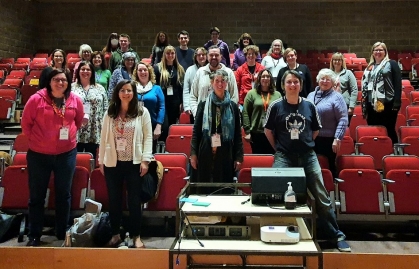
Rita Hulands has a genius for capturing pics of people immersed in what they're doingRita Hulands has a genius for capturing pics of people immersed in what they're doing

One of the features of last weekend’s Directors Day was hands-on practical work for all delegates. Faculty-led classes are a useful part of director training, but for skills-based learning you actually need to do the thing to get better at it. I had actually lined the model we used up to deliver in 2020, but we didn’t get to use it then. But it was ideal for our needs in 2022, as it all about connecting ear to gesture – that central driver of effective conducting that had been absent through the Zoom era.

The faculty met together the night before to do our own practical work. This doubles as both our opportunity to experience some input on our own directing before spending the main event helping everyone else, and the chance to work through the model so we’re all confident to deliver it to others.

LABBS Directors Day 2022

dirday2022

Almost two years to the day since the Ladies Association of British Barbershop Singers last held an in-person education event, we gathered in Coventry on Saturday for a day of director training. We had a curriculum built round various aspects of the recovery process all choruses are going through at the moment, underpinned by practical work for all delegates that focused on the relationship between listening and conductor gesture. This is the central element of the conductor’s craft, and precisely what had been ripped out of the process during the whole Zoom era.

A recurrent theme in this blog after these kinds of events is the sense of coming home with a full note-book. That cliché becomes meaningful again after such an education drought. For sure, there have been all kinds of online events to attend as either leader or delegate, and I learned things from both types of participation, but the richness and depth of learning you get with a room full of people is just in another league. I had conversations with a number of people about how we’d got to the point last year where we were just running on empty, and how nourishing it felt to finally spend time in person with other directors. The full pages of our notebooks reflect the refilling of our spirits.

The Performer’s Inner Family

bodykeepsthescoreI’ve recently finished reading The Body Keeps the Score: Mind, Brain and Body in the Healing of Trauma by Bessel van der Kolk. Its primary focus is the treatment of trauma, a specialised pursuit that has no direct relevance to my personal or professional lives. But in the process of explaining the difficulties experienced by people who have been damaged by shock, tragedy or abuse, he gives many and varied insights into how our internal landscapes - our memories, our sense of self - work.

One chapter particularly resonated with an experience of musicianship I have observed in both others and myself and called out for some reflection. Chapter 17 deals with a form of treatment called Internal Family Systems therapy, and is predicated on the idea that the self isn’t a single, unitary entity, but rather a mosaic of different parts.

More Director Coaching with Welwyn Harmony

All warm-ups should have a big mirror to help you get more people in the picAll warm-ups should have a big mirror to help you get more people in the pic

On Tuesday I was back with my friends in Welwyn to continue supporting their director development plan. This time I spent a good chunk of the evening working with each of their two Assistant MDs as well as doing some more work on their contest ballad with their front-line director. I do like teaching models that give people the chance to both do the thing and observe others doing it; the combination of direct experience and having the space to observe the effects of changes seems to help people acquire skills more efficiently than either in isolation.

Some of our work was refining technique: stabilising stance to make less of a moving target, connecting gesture level to the seat of the breath (or the ‘yo-ho-ho’ region to refer back to a pirate-themed warm-up exercise). Becoming more purposeful about the role of the non-dominant hand was a useful development for both AMDs: by giving it less to do as default, and only using it (either as momentary mirror to the dominant hand or to do something different) when you have a particular musical reason drastically increases your expressive range. As I say about writing: some days you measure progress in how much you write, some days in how much you delete.

Harmonic Explorations with Amersham A Cappella

AACfeb22

I spent a happy Tuesday evening with my friends at Amersham A Cappella, working on the music they are preparing to compete with at the European Barbershop Convention in Helsingborg in May. It was probably the closest to a ‘normal’ experience I’d had this side of the pandemic. Aside from the open door for ventilation, and the need to wear a mic so those unable to be there in person could watch via livestream, it felt just like old times.

Familiar faces helped this feeling of course – we have a long-standing relationship that made it easy to slot straight back into the kind of work we do together. And the nature of the work – diving deep into musical detail - slotted us back into a familiar context of how the major contest of events of the barbershop world organise the experience of their participants over the course of months.

On Arranging for Female Voices, Part 2: Vocal Behaviour

In my previous post about the differences in arranging for male and female voicings, I reflected on how little opportunity you get for genuinely tight voicings for ensembles working in lower registers. One of the things that brought this into focus for me recently was a conversation about a specific arrangement written in the women’s key, explaining why I didn’t feel it would work transposed down for a men’s group. The closely-voiced chords that bring spritz and joy in the higher register would become cloudy and unclear lower down.

Today’s subject has also provided a reason to decline to transpose particular arrangements down for men, though I’ve tended to remain somewhat veiled in my explanations for the decision. ‘It wouldn’t work well in the lower key’ is a kinder thing to say than, ‘I don’t think men will be able to sing that’.

So, what is it that I doubt men’s capacities to perform effectively? And why do I harbour that doubt?

On Arranging for Female Voices

There have been a number of productive conversations recently in the Barbershop Arrangers’ Facebook group about arranging for women’s voices, and why you can’t just transpose an arrangement for men up a 4th or a 5th and expect it to sound good. We can thank Amanda Nance for starting us off, and a good number of my fellow female arrangers have piled in sharing best practice.

Examples of things to consider have included: voicing the chords more tightly than you would for men, keeping the bari line below the lead more than above it, and care of tessitura, in particular not keeping tenors in the upper part of the range all the time, and ditto for the lower 3rd of the basses’ range. Just summarising these here so that when the detail of the discussions have been buried under the weight of subsequent threads, I’ve got a record of the key things shared at the time.

...found this helpful?

I provide this content free of charge, because I like to be helpful. If you have found it useful, you may wish to make a donation to the causes I support to say thank you.


Archive by date

Syndicate content