
Harmonic Charge, Voicing and Gesture

Right back in the early days of this blog I spent some time thinking about a set of related concepts in close-harmony arranging and performing: harmonic charge, its relationship with voicing, and – more esoterically – the latter’s relationship with vowel sounds.

I have gradually observed over the years that these concepts have specific implications for conducting gesture: harmonies with a higher inherent energy (harmonic charge and/or tighter voicing) need to be squeezed.

I notice this most clearly when in trouble-shooting mode as a coach. Directors will respond to the energy in these moments whether or not they have consciously analysed the chords, but they run into difficulties when they translate this into action by making their gestures bigger. On the face of it, that would be the standard thing to do, following the bigger=louder metaphor* that underpins traditional conducting technique.

Playlist 2017: 6th Commentary

Time for another catch-up on my Playlist project for 2017. I'm now over half-way towards my goal of 100 pieces this year, and I've yet to repeat a composer. Additions may accelerate this month, as I have more listening time than usual (and in anticipation of having less listening time later in the year).

  • Marianna Martines, Dixit Dominus (1774), 1st movement. I was aware of Martines as a composer for harpsichord, but her choral music is a pleasant revelation. This is a decent amateur performance – good enough for me to want to get my hands on it and make it an even better one!
  • L. Viola Kinney: 'Mother's Sacrifice' (1909). Quite captivating piece, speaking through the languages of both C19th pianism and American popular song. And some extraordinary uses of sequence, too.

    The video includes two more pieces by more recent composers, Dorothy Rudd Moore and Zenobia Powell Perry, so stay on and listen to those too.

A Dedication of Directors

Director Faculty in actionDirector Faculty in action

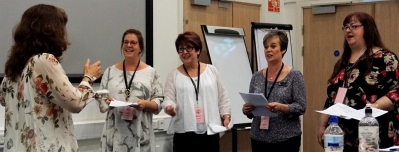
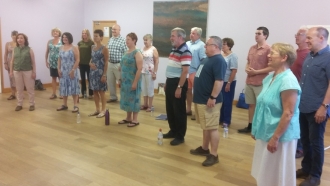
There was some discussion after last Saturday’s education day for LABBS chorus directors as to what the collective noun for directors was. We had lots of good suggestions, but I am going with ‘a dedication’ for now because of the way our delegates embraced the preparation we had set for the practical activities with such commitment, resulting in one of the most musically in-depth experiences I have yet managed to orchestrate in a single day.

The coaching model we used was devised, in the first instance, to answer the question as to how to offer practical skills training to lots of people with the resources we had available, You can teach a discussion-based class to a room of 70 people and it works, but hands-on skills need individual attention. In the process, it also answered another question of practical training I have been grappling with – how to develop directors’ musicianship skills. You can communicate ideas in a day, but musicianship takes ongoing work to flourish.

Inclusiveness Versus Diversity

‘Versus?!’ I hear you cry. It’s true that we usually use these two words interchangeably when we talk about opening up our choirs (or our schools or our boardrooms) to attract people from a wider range of demographics than hitherto. But the two words approach the same project from interestingly distinct angles, and once you start thinking through the differences it can affect how you go about that project.

The immediate context for this is the Barbershop Harmony Society’s new strategic vision, which I both praised and critiqued a few weeks back. The topicality is far wider than this, of course, but it was this set of debates that had me thinking about this in a more focused fashion, and coming to the conclusion that, if you want to get ‘Everyone in Harmony’, inclusiveness is a more useful term to focus on than diversity.

Carving Out an Interpretation with Red Rock Harmony

This shot just gives an inkling of the amazing rehearsal venueThis shot just gives an inkling of the amazing rehearsal venue

After my coaching sessions last week with Strictly A Cappella and Frisson, I headed down to Devon to work with my friends at Red Rock Harmony in Teignmouth. One of the things that is pleasing about repeat visits to a group is to hear how they have improved since you last heard them, and it was lovely to be able to remark on how much more vocally secure they are sounding than last autumn. And this was my third day in a row of groups with pitch integrity. It is a wonderful thing when you can trust the technique and just get on with the music.

For music was our task. The chorus are in the process of learning one of my arrangements, commissioned by another group a couple of years back, but as Red Rock Harmony have joined LABBS since its one and only previous contest performance, they are approaching it as if a brand new chart. My job was to work with them on the delivery, finding the fluidity flow of a barbershop ballad within the black-and-white dots on the page.

Friday Morning Frisson

FrissonThe morning after my evening with Strictly A Cappella, I had the opportunity to work with a mixed quartet from within the group called Frisson. The morning was fresher than the night before, so maybe one shouldn’t be so impressed to encounter as good an integrity of pitch in the sub-group as in the main ensemble, but it would seem churlish not to mention it.

One of the things that this tonal reliability facilitates is the capacity to drop into songs at (almost) any point, and focus your attention on just that bit you want to work on without a distracting run-up to it. There’s just much less cognitive overhead in finding your place if you share an implicit trust in where your tonal centre is rather than having to listen out for it and adjust to it anew each time you start to sing.

Strictly A Cappella

StrictlyI spent a hot and sticky Thursday night down in Radlett with Strictly A Cappella. We were working on bringing out the musical detail in a pleasantly varied range of songs – from Queen, to Duke Ellington, from Diana Ross to gospel. The heat and the closeness of the atmosphere make it all the more impressive to note that this is an ensemble that maintained absolute integrity of tonal centre all evening.

Their rehearsal room is quite small and quite lively, which for many vocal/choral genres can be dangerous – the risk is that people will get used to making a large resonant sound with the help of the walls and ceiling rather than with their own singing technique. But for a moderately large contemporary a cappella group like this, it actually makes their job harder. Much of their music benefits from quite intricate textures, and singing it in a space like that forces everyone to work much harder a keeping it clean and tight, so you don’t lose all the detail in the wash of sound.

On Singing All the Lines

It was almost 7 years ago when I wrote in detail about Making Parts into Lines. At the time I had just been working on the Mary Poppins set for Cottontown Chorus, and it remains a landmark moment in my development as an arranger. Not just because this was the first time any of my arrangements had won a contest gold, but because the process of working through the technical and artistic detail gave me musical insights that have informed my work ever since.

This was also the place where I first articulated the performer’s two roles – as Manager and Communicator – which have become very useful concepts in my coaching as well as my arranging.

...found this helpful?

I provide this content free of charge, because I like to be helpful. If you have found it useful, you may wish to make a donation to the causes I support to say thank you.


Archive by date

Syndicate content